Metacognition
What is metacognition?
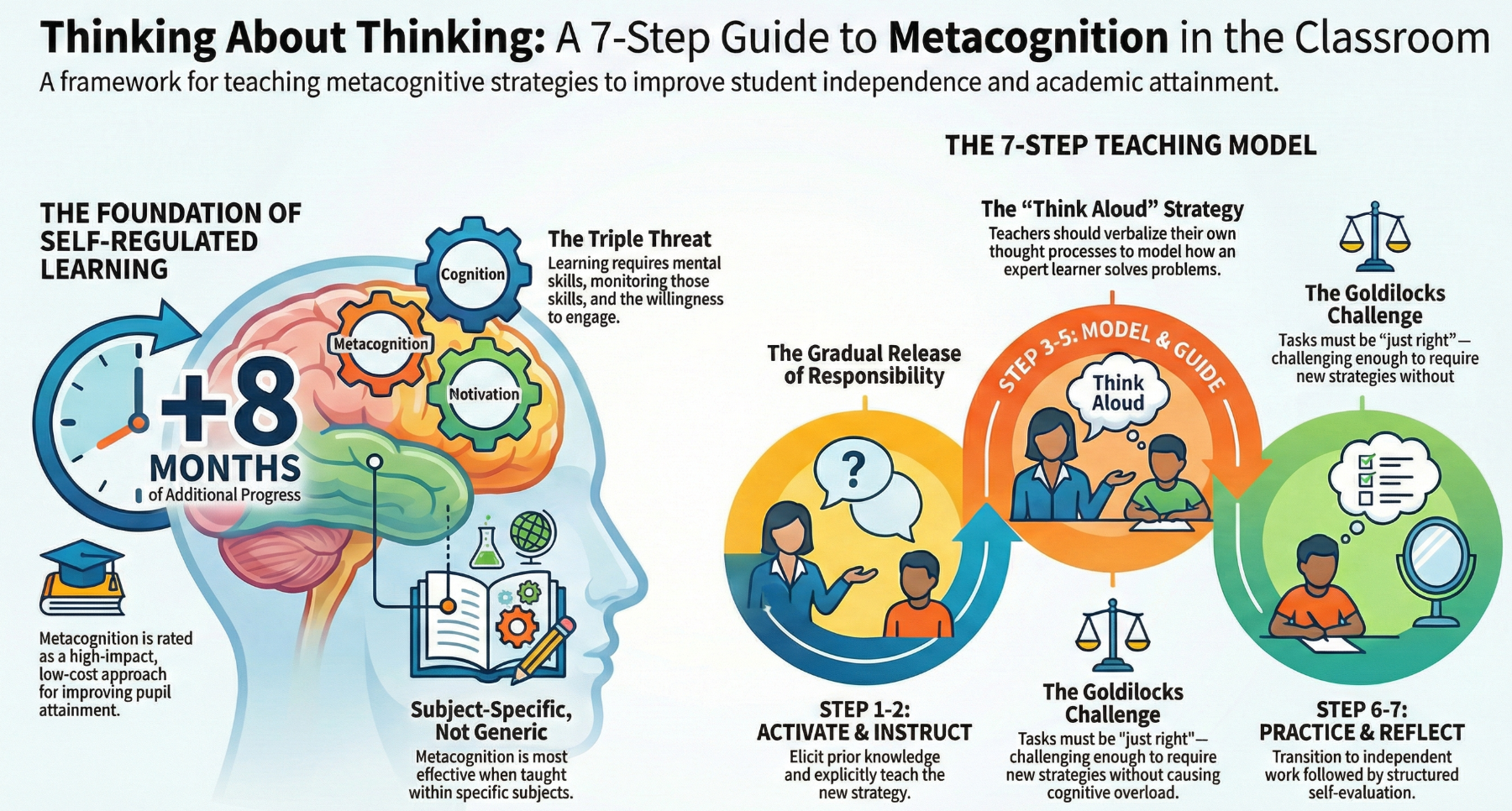
In simple terms, metacognition is "thinking about thinking" — a learner's ability to be aware of, reflect on, and direct their own mental processes. A metacognitive learner can plan how to tackle a task, monitor their progress while working, and evaluate their success afterwards.
Cognition
The actual mental skills used to complete a task.
Metacognition
Awareness and control of how those skills are used.
Motivation
The willingness to engage with a task and keep going.
Why it matters
Research from the Education Endowment Foundation (EEF) shows teaching these skills is one of the most effective ways to improve pupil progress. It's especially valuable in a world where AI can provide quick answers — a metacognitive learner knows to ask, "Does this match what I already know?" and "Is this source reliable?"
The learning cycle: plan, monitor, evaluate
1Planning
Before the task: "What do I already know? What's my goal? Which strategy will work best?"
2Monitoring
During the task: "Is this working? Am I following my plan? Do I need a different approach?"
3Evaluating
After the task: "How did I do? What worked well? What will I do differently next time?"
How we teach it in school
Our teachers use a step-by-step model to help children move from following a teacher's lead to working independently:
Activating prior knowledge
Helping children remember what they already know.
Modelling
The teacher "thinks aloud" while solving a problem, so children can hear an expert's thought process.
Guided practice
Children try the task with support and prompts.
Independent practice
Children take the lead to build their own expertise.
Reflection
Lessons end by discussing not just what was learned, but how it was learned.
How you can help at home
You don't need to be an expert in the subject to support your child's metacognition — just ask open-ended questions that prompt them to think about their process:
To help them plan
"What do you need to do first? Have you done anything like this before?"
To help them monitor
"How's it going? Is there a part you're finding tricky? What else could you try?"
To help them evaluate
"What are you most proud of? What would you do differently next time?"
To help them stay focused
Encourage a good learning environment — putting phones in another room helps avoid distractions.
Is my child too young?
It's never too early to start. Children as young as three can begin to set goals and check their own understanding — habits that support them all the way through primary school, secondary school, and beyond.
What is metacognition?
In simple terms, metacognition is "thinking about thinking" — a learner's ability to be aware of, reflect on, and direct their own mental processes. A metacognitive learner can plan how to tackle a task, monitor their progress while working, and evaluate their success afterwards.
Cognition
The actual mental skills used to complete a task.
Metacognition
Awareness and control of how those skills are used.
Motivation
The willingness to engage with a task and keep going.
Why it matters
Research from the Education Endowment Foundation (EEF) shows teaching these skills is one of the most effective ways to improve pupil progress. It's especially valuable in a world where AI can provide quick answers — a metacognitive learner knows to ask, "Does this match what I already know?" and "Is this source reliable?"
The learning cycle: plan, monitor, evaluate
1Planning
Before the task: "What do I already know? What's my goal? Which strategy will work best?"
2Monitoring
During the task: "Is this working? Am I following my plan? Do I need a different approach?"
3Evaluating
After the task: "How did I do? What worked well? What will I do differently next time?"
How we teach it in school
Our teachers use a step-by-step model to help children move from following a teacher's lead to working independently:
Activating prior knowledge
Helping children remember what they already know.
Modelling
The teacher "thinks aloud" while solving a problem, so children can hear an expert's thought process.
Guided practice
Children try the task with support and prompts.
Independent practice
Children take the lead to build their own expertise.
Reflection
Lessons end by discussing not just what was learned, but how it was learned.
How you can help at home
You don't need to be an expert in the subject to support your child's metacognition — just ask open-ended questions that prompt them to think about their process:
To help them plan
"What do you need to do first? Have you done anything like this before?"
To help them monitor
"How's it going? Is there a part you're finding tricky? What else could you try?"
To help them evaluate
"What are you most proud of? What would you do differently next time?"
To help them stay focused
Encourage a good learning environment — putting phones in another room helps avoid distractions.
Is my child too young?
It's never too early to start. Children as young as three can begin to set goals and check their own understanding — habits that support them all the way through primary school, secondary school, and beyond.