Inclusion & SEND (Special Educational Needs)
Leaders have high ambitions for pupils with special educational needs and/or disabilities (SEND). When necessary, teachers adapt lessons so these pupils can access the same curriculum as their peers, at the same time. Well-trained teaching assistants provide effective support in class when needed. However, adults also successfully encourage pupils to work on their own or with others. This helps them to build independence. – Ofsted, November 2022
What is SEND?
SEND means Special Educational Needs and Disabilities. There are four broad categories of SEND:
-
communication and interaction;
-
cognition and learning;
-
social, emotional and mental health;
-
physical and sensory.
Springcroft Primary School provides pupils with a broad, balanced curriculum with high-quality teaching that is adapted or differentiated to the learning needs of all. Pupils are regularly assessed by the class teacher and appropriate members of the school team and where it is felt that additional support may be needed, interventions are considered. We work closely with multiple agencies and professionals to seek the best support and signpost to further support for learners and families. Slow progress and low attainment will not automatically mean that a pupil has SEND.
At Springcroft, all class teachers are responsible for providing a curriculum that is suitable for all pupils in the class, including those with Special Educational Needs or Disabilities (SEND) with support from the SENCO. We have high expectations for all pupils and are committed to ensuring our curriculum complies with the Equality Act 2010 and the Special Educational Needs and Disability Regulations 2014. Our inclusion statement emphasises the importance of providing an inclusive learning environment for all pupils including those with SEND. Additional information on this can be found in our Special Education Needs Information for Parents and Equalities Policy.
Graduated Response
Springcroft Primary School follows the Graduated Response as set out in the SEND Code of Practice.
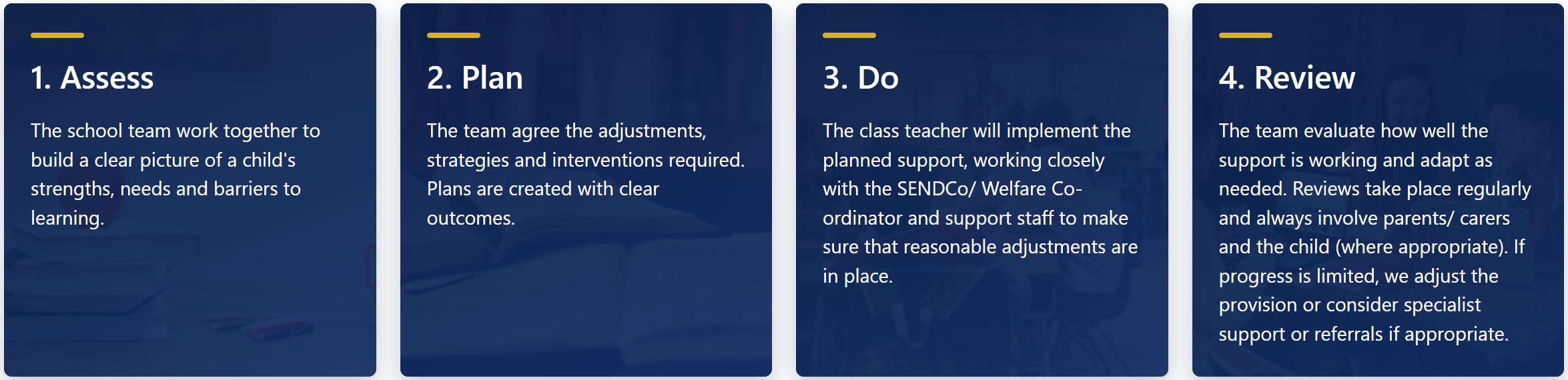
Springcroft Primary School is part of the local SEND & Inclusion Hub, where additional advice and support can be sought from external specialists and other SENDCOs. Through the hub, schools can request an Enhanced Assess, Plan, Do, Review (EAPDR) process and a range of support strategies or services.
For pupils who may have significant or more complex needs or who fail to make expected levels of progress despite SEND support, school and/ or parents/carers may consider applying to the Local Authority for an Educational Health Care Plan (EHCP)
Special Educational Needs Co-ordinator (SENDCO)
Springcroft Primary School has an experienced and qualified leader of SEND who is responsible for overseeing SEND Provision and arrangements for pupils with identified special educational needs or disabilities (SEND). Our Special Educational Needs Co-ordinator (SENCO) is Mr G. Rowley. He can be contacted through the school office on office@springcroft.staffs.sch.uk or 01782 394793
Any concerns about your child should be raised with your child’s class teacher in the first instance. You can arrange to meet with them either before or after school by speaking to them directly or by contacting them via ClassDojo or through the school office on 01782 394793 to arrange an appointment.
Additional advice and support in Staffordshire:
Additional advice and support in Staffordshire:
SEND Local Offer
The SEND Local Offer is the place to go for information, support and services for children and young people with special educational needs and disabilities from 0-25 years.
Staffordshire SENDIASS
Staffordshire Special Educational Needs and Disabilities Information Advice and Support Services.
Staffordshire Connects
This is an online directory which serves as a central hub for information and referrals for a wide range of service for adults, young people and families in Staffordshire.
Inclusion
Inclusion sits at the heart of our schools’ ethos. We want every child to feel valued, supported and understood. Our staff team work closely with families and professionals to endeavour to create the conditions where each pupil can flourish academically, spiritually, socially and emotionally.
Accessibility
Our school offers an Accessibility Plan ensuring pupils can:
-
access the curriculum;
-
participate fully in school life;
-
enjoy safe and inclusive environments;
-
receive reasonable adjustments where needed.
SEND Information Report 2026-2027
This report answers the specific questions every school must publish about supporting children with special educational needs and disabilities (SEND), and should be read alongside the information above. Click a question below to open it.
Last reviewed: September 2026. This report is reviewed annually.
How do you know if my child needs extra help?
We look out for:
- concerns raised by parents/carers, teachers or a previous school;
- half-termly attainment tracking showing a lack of progress;
- ongoing difficulty despite support, or a high level of need when a child joins us;
- little or no progress after two cycles of assess, plan, do and review; or
- observations suggesting a need in one of four areas - communication and interaction, cognition and learning, social, emotional and mental health, or sensory/physical.
If we believe a child has special educational needs, we add them to our SEN list, let parents know, and agree next steps together. Targets are recorded on a Provision Map or Personal Learning Plan, which we track in school and review regularly with parents.
How is teaching adapted for my child?
Class teachers, supported by the SENDCO, plan using each pupil's current level of achievement so that work is matched and appropriately challenging for everyone in the class. Additional support may include help from a teaching assistant - in class, in a small group, or individually - or resources such as a sloping board, ICT access or visual prompts.
If your child continues to find things difficult, we seek advice from specialist services, for example speech and language therapists, hearing/visual impairment teachers, health professionals, SEND support teachers or educational psychologists.
We run a range of targeted programmes across the four areas of need, chosen to match each child's individual needs, including Alphabet Arc, SNIP, Precision Teaching, EPATT (reading, spelling and maths), memory programmes, reading interventions, SOS spelling, Toe by Toe, Hornet Word Wasp, Power of 2, Power of Plus One, PINDORA, and speech and language programmes.
Since September 2014, children with significant special educational needs (aged 0-25) may also undergo an Education, Health and Care (EHC) needs assessment, following professional advice, unless the family opts out.
How will I know how my child is getting on?
We share progress towards learning outcomes with parents each term through Parents' Evenings, annual reports and individual reviews. Provision Maps and Personal Learning Plans are updated at the end of each term, so you'll always know where your child is against age-related expectations, where we hope they'll be, and how we're helping to close any gap.
If a specialist service is involved, reports are shared with both school and parents so everyone understands the next steps. We're happy to arrange meetings with outside agencies on request, and where a parent has SEND themselves, we'll go through any written reports verbally as well as providing a copy.
You're welcome to speak to your child's class teacher, the SENDCO or a member of the senior leadership team at any time - just contact the school office to arrange a convenient time.
How can I support my child's learning at home?
We'll provide guidance, resources and any specific items you need, and will signpost parent-training opportunities offered by outside agencies as they arise. From time to time, our SENDCO and HOPE Well-Being Mentor also run coffee mornings and training sessions for parents of children in particular year groups.
How is my child involved in planning and reviewing their own progress?
We talk to every child individually so they understand where they're at in their learning, including when support is no longer needed because a gap has closed. Children have regular opportunities to raise anything they're finding difficult with their class teacher or teaching assistant.
All children can take part in reviewing their own provision - for example through an EHCP questionnaire, or discussions with subject leaders, the headteacher, the SENDCO or governors.
How do you support my child's wellbeing, behaviour and safety?
Pastoral support is a priority for every child. Our HOPE Project offers a listening ear and well-being support; all staff are trained in emotion-coaching techniques, and sensory equipment is available in classrooms to help children self-regulate. Children can also take a short, supervised walk if they're finding things hard emotionally or behaviourally.
If behaviour becomes a significant concern, we may seek support from the Behaviour Support Team or the SEND Inclusion Hub, and, with parents' agreement, put a behaviour or pastoral support plan in place. Where needed - and always with parental permission - we'll refer to CAMHS for further support.
Around the school day: the headteacher greets parents on the playground each morning; Early Years children are met by staff at their outdoor gate; and there are always at least two staff supervising at playtimes, with extra support arranged for children with an EHCP or specific medical or behavioural needs.
What if my child has medical needs?
Children with medical needs have a detailed Health Care Plan, prepared with the school nurse in partnership with school, parents and, where appropriate, the child. A medication administration form must be completed by parents before we can give any medication, and staff who administer medicines are trained in line with Staffordshire County Council guidance and the DfE's Supporting Pupils at School with Medical Conditions (2014).
Please let the school office know about any medical appointments so they can be recorded as an authorised absence.
What expertise and training does your staff have?
Your child may be supported by:
- the SENDCO, who oversees SEND policy and practice with the senior leadership team and governors;
- our Mental Health and Wellbeing Lead, through the HOPE Project;
- the class teacher, who sets targets and plans additional support;
- teaching assistants, who support individuals and groups; and
- specialist support commissioned as needed, for example educational psychologists, the Autism Outreach Team, speech and language or occupational therapists, or the Moorlands SEND Inclusion Hub.
We invest heavily in ongoing training. Since 2020, staff have completed training including: SENCO updates; SEND maths; Level 3 and Level 5 SEND diplomas; positive handling and de-escalation; speech and language (with Stoke Speaks Out); emotion coaching, including training-the-trainer; sensory awareness and sensory classroom projects; asthma and paediatric first aid; bereavement support; Pathological Demand Avoidance; understanding autism, ADHD, dyslexia, dyscalculia and tics; attachment and trauma, including for looked-after children; self-harm awareness; working memory difficulties; Makaton awareness; restorative practice; PlayMobilo therapy; sensory integration; supervision skills for reflective practice; and supporting worried or anxious children and friendship issues.
How are resources, equipment and funding provided?
Every classroom has age-appropriate visual timetables, maths apparatus, number lines and word mats, and an accessible sensory workstation. We hold sloping tables, overlays and cushions in our own SEND stock, and will order any individual item recommended by a specialist or the SENDCO as soon as the need is identified.
All Staffordshire mainstream schools receive delegated SEND funding through a formula based on factors including attainment, free school meal numbers and the number of pupils with SEND. Where extra specialist support is needed, we can apply to the Moorlands Inclusion Hub for additional funding.
Decisions about the type and level of support are made jointly, by the SENDCO, headteacher, class teacher and parents where there is no Education, Health and Care Plan, or as part of the EHC planning process with the local authority where one is in place.
Which outside agencies and services can help?
Local authority:
- Specialist SEND Support Teachers and Educational Psychologist - 0300 111 8030
- Autism Outreach and Visual/Hearing Impairment Team - 01785 356830
- Behaviour Support Team - 0300 111 8030
- SEND Assessment and Planning - 0300 111 8007
Medical:
- Occupational Therapy, Physiotherapy, Speech and Language Therapy and the School Nurse - 0300 123 1161
- Child and Adolescent Mental Health Service (CAMHS) - 0300 123 0907
You can also find support through the Staffordshire SEND Local Offer, Staffordshire SENDIASS and Staffordshire Connects, linked above.
What support is there for looked-after children?
We hold regular Personal Education Plan (PEP) meetings bringing together the Designated LAC Teacher, class teacher, headteacher, carers and social worker, usually with the child invited to share their views towards the end of the meeting. Specialist equipment is purchased where needed to meet individual needs. See our Looked After Children Policy for further detail.
How will you support my child when joining, transferring or moving on?
No child is refused admission on the basis of a special educational need. In line with the Equality Act and the SEND and Disability Regulations, we will not discriminate against disabled children and will take all reasonable steps to provide effective support - see our Admissions Policy for details, or call the school office on 01782 394793 to arrange an open evening, open day or individual visit.
Joining us: we run a planned programme of visits in the summer term for new starters, and our Reception teacher visits children in their current early years setting. New parents are invited to an information meeting, and the SENDCO and class teachers meet with the parents of any child already known to have SEND before they start. Where a child transfers from another school, we request records immediately and arrange a meeting with the headteacher and parents.
Moving on: when your child moves to another school, including on to high school, we hold joint meetings between SENDCOs and teachers, and offer extra transition visits and summer school so your child can build confidence and friendships before they start. For children with an EHC plan, we hold formal transition meetings, arrange extra visits where needed, and submit a transition report to the local authority.
What about extra-curricular activities, wraparound care and EAL support?
Our curriculum includes a wide range of extra-curricular clubs, visits, visitors and trips, and we want every child to take part. Risk assessments and reasonable adjustments are made wherever needed, always in consultation with parents and pupils.
Before- and after-school care runs from 7.30am-6pm: £4.50 per morning session; £4.50 per hour per child after school, reducing to £2.25 per child between 5.30-6pm. Time4Sport also run holiday clubs on-site - details are shared via ParentMail/Teams ahead of each holiday.
For children whose parents' first language is not English, we contact MEAS for advice and resources, and signpost staff to the EAL support pages on Staffordshire Connects.
How accessible is our school building?
We have ramp access and ground-floor changing and toilet facilities, and there's a disabled parking space in the staff car park - please show your blue badge at the school office and we'll issue you with an access code for future visits. Two classrooms and our ICT suite are on the first floor, reached by stairs. Teaching tools and resources are matched to pupils' needs (for example, supporting visual impairment or dyslexia), and our library provides a soft, quiet space that can also be used as a nurture area.
Classrooms have interactive whiteboards, networked PCs and laptops, and further SEND resources are available through the Local Authority's Inclusion/SEND Support Teams or an application for additional needs funding.
How can I get involved as a parent or carer?
We warmly welcome parents into school life - supporting reading or art in a class your own child isn't in, joining trips as an extra adult (subject to a DBS check), or joining our Springcroft Fund-Raisers, who've recently funded a pirate ship for our Key Stage 1 playground and iPads for whole-school use.
We also run parent workshops (times tables in Year 4; SATs in Years 2 and 6; phonics in Reception and Year 1), Meet the Teacher evenings in September, Christmas and Easter performances, Sports Day, and Macmillan coffee mornings hosted by Year 6. Parents can also apply to become a governor when a vacancy arises - register your interest with the school office.
How is SEND provision governed?
Our governing board includes parents, staff, community and local authority representatives, and is constituted under the School Governance (Constitution) Regulations 2012. Governors set the school's vision and strategic direction, monitor progress and attainment, oversee staffing and safeguarding, and manage the school budget - always reflecting our values of integrity, creativity, resilience and collective responsibility. The full governing board and its Finance Committee each meet three times a year.
Our SEND Governor, Mrs G Hammond, visits each term to meet the SENDCO, review provision for pupils with SEND, disabilities, pupil premium, looked-after children and EAL, and to talk to pupils about their progress.
Who do I contact with a question, concern or complaint?
In the first instance, please speak to your child's class teacher. You can also contact our SENDCO, Mr G. Rowley, or our headteacher, Mr S. Drew, via the school office.
Staffordshire SENDIASS (independent advice) - 01785 356921
For a formal complaint, please contact the school office for our Complaints Policy; complaints are addressed to the Chair of Governors via our Clerk to Governors, Mrs Ruth Silcock.
SEND: guide for parents and carers
For further details and information, please see our SEND Policy.
For complaints please contact the school for the Complaints policy and address to the Chair of Governors via our Clerk to Governors, Mrs Ruth Silcock.